The protagonist
Trần Thắng Tất
Two years in, fast at his job, fourth on the speed leaderboard. Everything is fine, so fine that he has nothing left to write in his notebook.
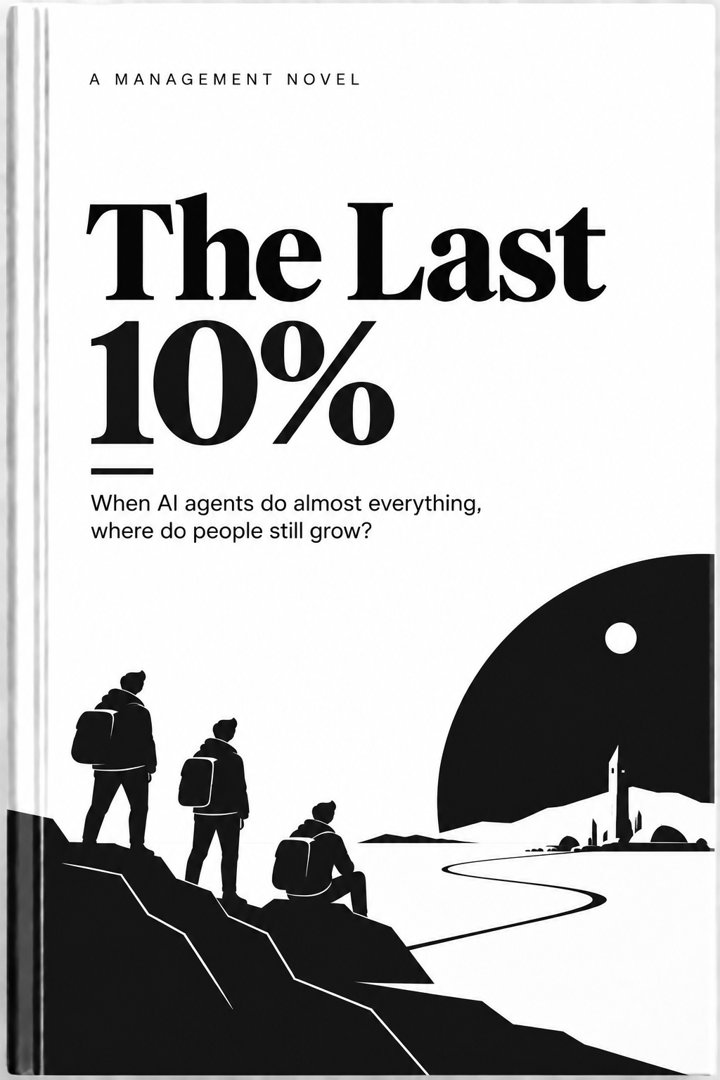
When AI agents do almost everything, where do people still grow?
New chapters every week. Subscribe to the newsletter on LinkedIn
1,134 newsletter subscribers
“At Hải Đăng, agents did ninety percent of the work. Thắng Tất handled the last ten.”
Hải Đăng, Vietnamese for “lighthouse”, rents out AI agents by the month. Its customers are more than ten thousand companies run by a single CEO: a yarn shop owner, a dentist, a small garment workshop, each with a team of agents that keep the books, greet customers and answer messages at midnight.
Behind the platform, the actual humans barely fill two rows of desks. They take the cases the agents cannot solve. And they have started to wonder: if a machine can do ninety percent of my job, what is the other ten percent?
The book places old lessons about how people work together in a world their authors never imagined. Mostly, they hold even better.
Two years in, fast at his job, fourth on the speed leaderboard. Everything is fine, so fine that he has nothing left to write in his notebook.
Among the first people at Hải Đăng. Quiet, but he remembers every customer who had to report something a third time.
Almost twenty years of work, from call centres staffed entirely by people to the age of agents. Always carries a worn old book, and only likes to talk in places with no meeting tables.
A hard case, a meeting, an afternoon by the river.
The story set beside well-tested management research, from Toyota’s Kaizen to psychological safety.
A few questions to take back to your own work.
Epilogue · Where There Is a Will. One more afternoon by the river, but this time it is Thắng Tất holding the old book.
The Third Report
At Hải Đăng, agents did ninety percent of the work. Thắng Tất handled the last ten.
Hải Đăng, Vietnamese for “lighthouse”, rented out AI agents. Its customers were a new kind of business that had sprung up over the past few years: the one-person company. A single CEO, backed by a team of agents rented by the month. An accounting agent, a sales agent, a customer care agent, a purchasing agent. More than ten thousand companies like that ran on Hải Đăng’s platform. Behind the platform, the actual humans barely filled two rows of desks.
Trần Thắng Tất sat in the second row, on the customer operations team. His job was to handle the cases agents couldn’t resolve on their own, or the ones where a CEO didn’t like how an agent had resolved them. Each case arrived on his screen with a short chime. Two years, about a hundred chimes a day. So many that some nights, lying in bed, he could still hear them.
Thắng Tất was fast. He could read a conversation between a CEO and an agent in seconds, spot exactly where the agent had misunderstood, fix the configuration and close the ticket. Last week’s leaderboard ranked him fourth for handling time. He wasn’t the best, but nobody ever complained about him either.
And that was the problem. Everything was fine.
On his first day, Thắng Tất had been so nervous he read every line of an agent’s reasoning like a detective novel. He filled three pages of a notebook with the kinds of mistakes agents tended to make, and kept asking the trainer why the sales agent greeted customers so stiffly. Now the notebook sat in a drawer, its cover gathering dust. He didn’t need it anymore.
Chapters 1 to 3 are out. The book is available on Amazon.
9 lessons Thắng Tất wrote down across the first 3 chapters, gathered on one page. It grows every Monday.
Open the notebook →If you finish a chapter wanting to argue with Trung, or to stand up for Thắng Tất, the book has done its job.