A Customer of His Own
On Monday morning, Trung put a printed sheet of paper on Thắng Tất’s desk. At Hải Đăng, where everything lived on a screen, a sheet of paper crossing the office was enough to make a few people look up and follow it with their eyes, the way you might look at a handwritten letter in the age of text messages.
“New customer,” Trung said. “A dental clinic. One dentist, no assistant. She wants to rent two agents: a receptionist agent to answer the phone and handle bookings, and an aftercare agent to look after patients once they’ve been treated. You’re in charge, start to finish.”
Thắng Tất read the sheet once, then read it again. For two years he had only ever fixed things other people had broken. Not once had he built something with his own hands, starting from a blank page.
“Why me?”
“Because you’re the one who found the price list flaw for the yarn lady,” Trung said. “Someone who takes the trouble to find where it hurts should get a chance to treat it at the root.”
Dr. Diệp was nearly forty and had a small clinic deep in an alley near the market. She did the examinations herself, the extractions, the fillings, took the payments herself, and was the one who switched off the lights after the last patient left. On their first call she spoke quickly and to the point, in the voice of someone used to living by the clock:
“I don’t need an agent that’s good at dentistry. I need it to answer the phone for me, book appointments for me, and let me sleep after ten at night.”
Thắng Tất finished in a single afternoon. This was what he was good at. Working hours, price list, appointment reminder templates, the post-extraction care guide that came ready-made on the platform: one by one they were loaded in, neat as books on a shelf. When it was done, he tried asking the agent a few questions. What is dry socket. How should painkillers be taken. How long before you can eat hard food. The answers appeared almost instantly, coherent, correct, not a word wasted.
It knew more about teeth than he did. Far more.
For the first time in two years, Thắng Tất sat in front of an agent and felt more like the student than the teacher. The feeling only brushed past him, like a cold draught slipping through a gap in the door. He switched off his screen, shouldered his backpack and went home, without giving it another thought.
Two Fixes
The agent had been running for three days when something happened.
At twenty past eleven on Thursday night, in a dark room somewhere in the city, a twenty-year-old woman who had had a wisdom tooth pulled that afternoon picked up her phone and typed, one word at a time:
“I’m still bleeding a bit, is that okay?”
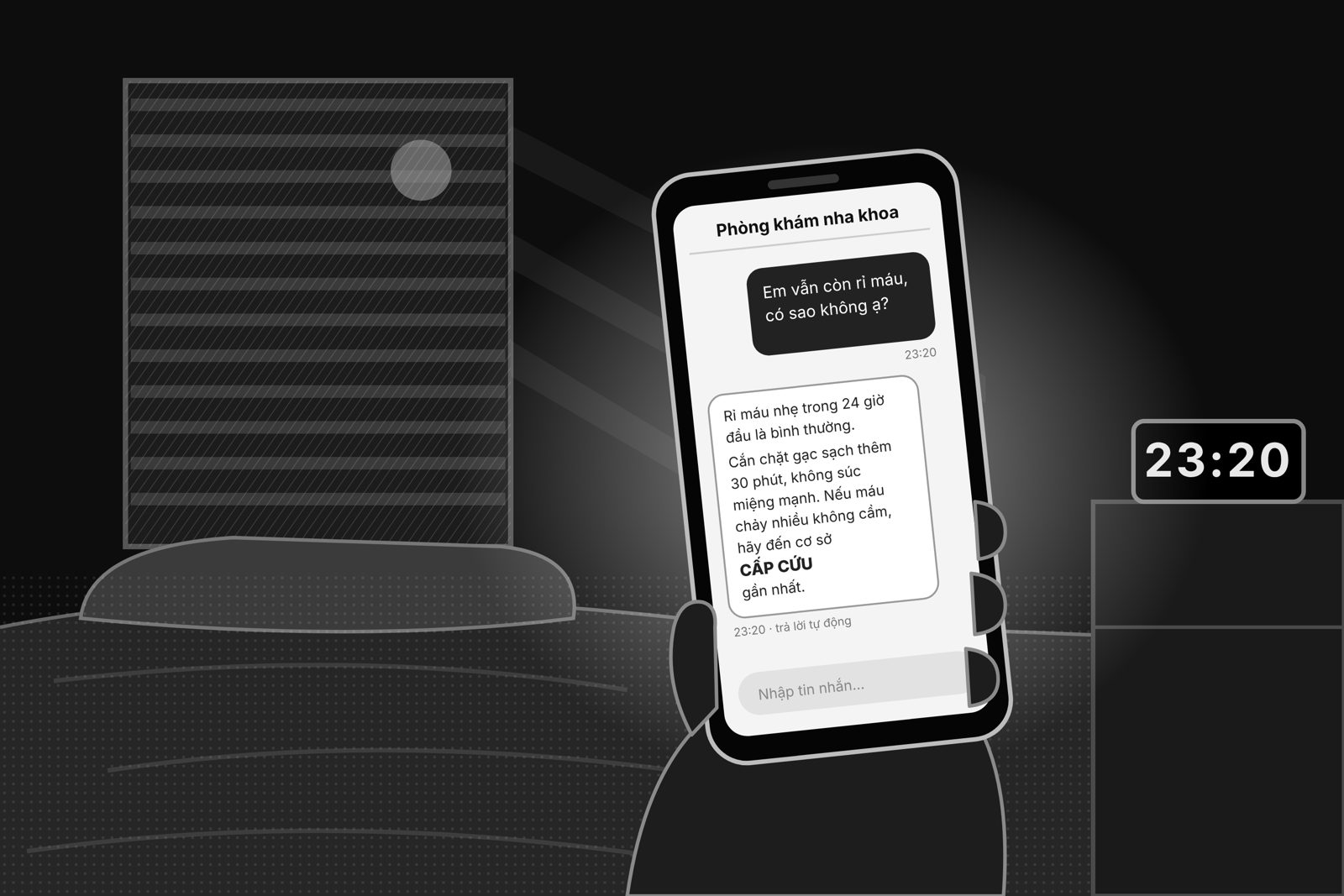
Three seconds later, the answer appeared. There was not one wrong word in it. Light bleeding in the first twenty-four hours is normal. Bite down firmly on a clean piece of gauze for another thirty minutes. Do not rinse vigorously. If the bleeding is heavy and will not stop, go to the nearest emergency facility.
Twelve minutes later, Dr. Diệp’s personal phone rang. On the other end of the line, someone was crying.
The next morning, a summary of the call sat on Thắng Tất’s screen, with a short note from the dentist: “The agent didn’t say anything wrong. But the girl read the word ‘emergency’ and panicked.”
He read through the conversation again. It was true: nothing wrong. Then he did what he did every day. He softened the tone, removed the word “emergency”, and added a reassuring line at the end. Ten minutes and it was done. The ticket closed with the familiar words: Resolved.
Six days later, another patient really was bleeding heavily. He read the agent’s new reassuring line, felt calmer, and sat waiting until morning. All night, the agent was awake. It was always awake. It just didn’t know that at the other end there was a man sitting silently in the dark, watching the gauze in his hand slowly turn red.
Luckily, by morning, everything was still all right.
This time Dr. Diệp called Thắng Tất directly. Her voice wasn’t loud. Just cold.
“Last week it frightened people. This week it reassured them at the wrong moment. Do you even know what you’re fixing?”
Thắng Tất opened his mouth, then realized he had nothing to say.
Trung’s Question
That afternoon it rained. Trung invited Thắng Tất down to the café on the ground floor and picked the table by the glass door. Outside, the rain fell in long diagonal lines, slowly blurring the street like a watercolour someone had spilled water on.
Thắng Tất told him everything: the first fix, the second fix, Dr. Diệp’s ice-cold voice.
“I did exactly what she complained about,” he said. “She said it frightened people, so I made it gentler. She said it made people careless, so I changed it back. I keep swinging between the two ends, like a pendulum.”
Trung stirred his coffee for a long time before he spoke.
“You know how. You’re one of the fastest people in the company at configuring agents. But do you know why?”
“Why what?”
“Why a girl who got the right answer still called her dentist in the middle of the night.”
“The agent already knows all that,” Thắng Tất said. “It knows why light bleeding is normal, why you have to bite on the gauze. It knows more than I do.”
“It knows why light bleeding is normal,” Trung said slowly. “But does it know why she was crying?”
The rain against the glass suddenly sounded much louder. Thắng Tất didn’t answer.
Trung took the old book the whole team had grown used to seeing out of his bag, opened it to a page with a folded corner, and slid it across to him. One line was underlined in pencil, the mark faded by the years:
For decades people have talked about transferring technology, transferring know-how, but know-why is what real knowledge is.
Knowing how, and knowing why. The author believed that understanding why was the highest level of understanding, higher than knowing what and higher than knowing how.
“I’m not going to answer it for you,” Trung said. “I’ll just ask one more question. Where are you planning to look for that why? In the configuration table?”
He stood up and left the book on the table. “Take it home and read it for a few days.” At the counter, the cashier didn’t charge him. She only gave a slight nod, as if greeting someone she had known for a long time. Thắng Tất watched, and assumed Trung must have a membership card.
That night, Thắng Tất couldn’t sleep.
At one in the morning, the only light in the room came from his phone screen. He read the girl’s message again, for the tenth time. I’m still bleeding a bit, is that okay? Then he opened Trung’s book and leafed back and forth until he stopped at another passage marked in pencil:
Those who have not experienced it should not yet teach.
He read the line many times, and each time it grew a little heavier, like pebbles being laid one by one on his chest. In his whole life he had never set foot in a dental clinic. He had never met a single one of Dr. Diệp’s patients. And yet for the past ten days he had been the teacher, patiently teaching a machine how to talk to people who were afraid, about a fear he himself had never known.
And the machine had learned very well. It had learned exactly the words he taught it.
He opened the notebook and wrote one line: I know how. I don’t know what they’re afraid of.
At seven in the morning he messaged Dr. Diệp and asked if he could come and sit in the clinic for a day.
Theory corner – Single-loop and double-loop learning
In 1977, Chris Argyris wrote Double Loop Learning in Organizations in the Harvard Business Review. He explained it with the image of a thermostat. A thermostat set to 20 degrees switches on when the room is cold and off when the room is hot. That is single-loop learning: spot a deviation and correct it, but never ask why it is 20 degrees. Double-loop learning is when people go back and examine the assumption behind that number.
Argyris found that many organizations, even ones full of talented people, get stuck in the single loop. They fix errors very quickly, but the errors keep coming back in a different shape. Thắng Tất’s two adjustments to the agent’s tone were two single loops. Trung’s question, why the girl still called, was the door to the double loop. And Trung deliberately did not walk through that door for him.
A Day at the Clinic
Dr. Diệp was a little surprised, but she agreed, on one condition: no questions while she was working.
The evening before, Thắng Tất messaged Lực Sỹ: “I’m going to the clinic tomorrow. Any advice?”
Lực Sỹ replied with exactly one line: “Don’t bring solutions. Go empty-handed.”
Thắng Tất didn’t fully understand what he meant. He opened Trung’s book and found a chapter about the immigrant. The author said that if you want to be able to work and create at all times, you must always live like an immigrant. An immigrant arriving somewhere new is afraid. They know no one. And they have nothing in their hands.
The hardest part is “having nothing”. A person can have two things: wealth and knowledge. Wealth can’t be thrown away. But knowledge can be “thrown away”, by giving all of it to the people around you. Then what you know lives on in others, and you return to zero, and have to set out again in search of something new.
Thắng Tất read the last passage twice and still didn’t understand it. How does giving to others leave you with nothing? He closed the book. The first two things he understood at once. Tomorrow he would be afraid, and he would know no one.
The next morning he left his laptop at home. He brought only the notebook.
The clinic was smaller than he had imagined. One dental chair, one instrument cabinet, a row of plastic chairs for people waiting, and the faint smell of antiseptic everywhere, seeping even into his shirt. He sat in the farthest corner, trying not to be in anyone’s way. For the first time in years, he felt like a spare part in a workplace.
Dr. Diệp worked without a break. But by the second patient he noticed something. Before every extraction, she leaned down and said, softly, exactly one sentence:
“I’ll message you at nine tonight to see how you’re doing.”
With the third patient she said it again. With the fourth, the same.
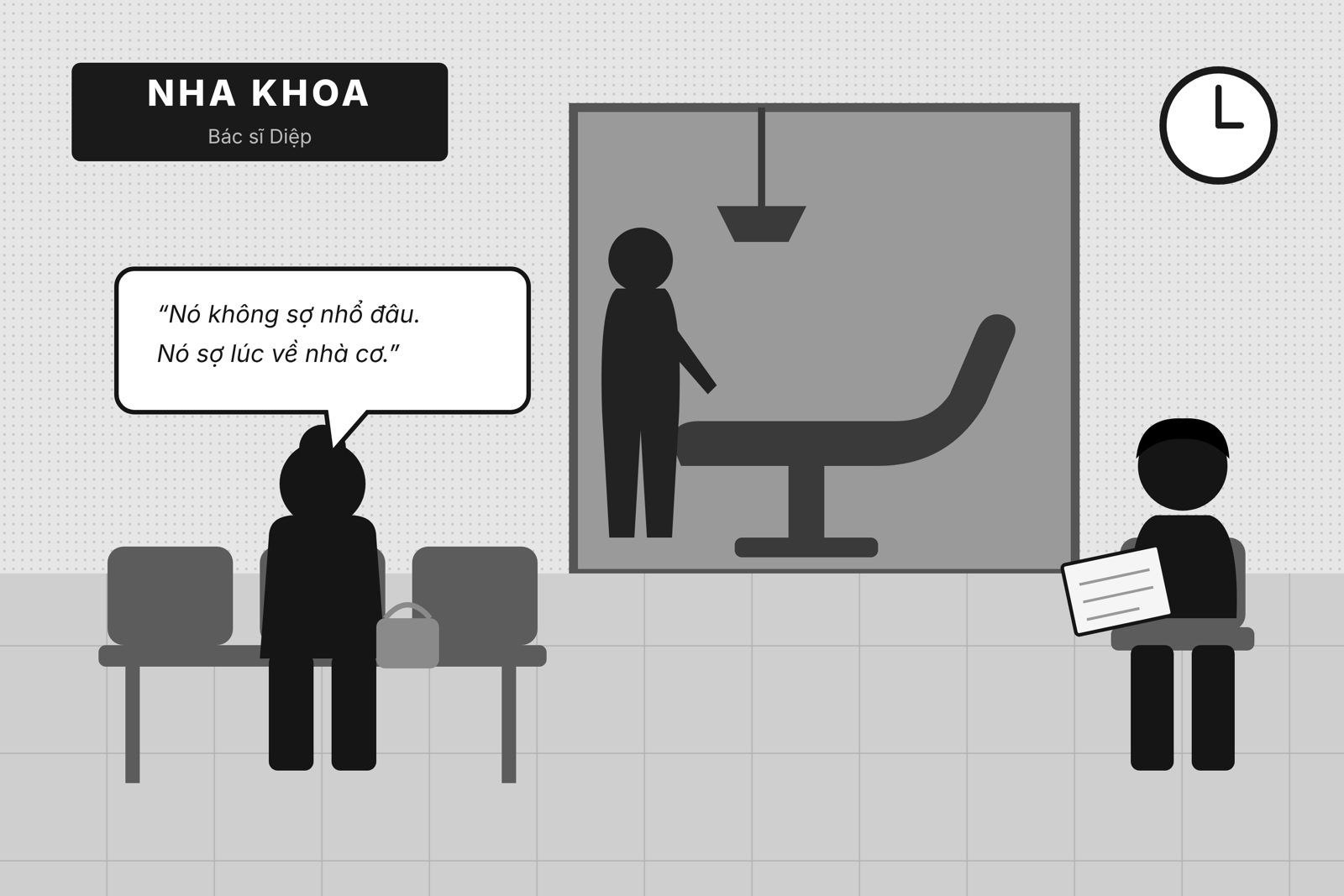
Around noon, an old woman who had brought her granddaughter to have a tooth pulled started chatting with Thắng Tất, assuming he was also there with a patient.
“My girl isn’t scared of the extraction. She’s scared of afterwards, at home. Here there’s a doctor. At home nobody knows what’s normal and what isn’t. Dr. Diệp used to message every evening.” She paused, her eyes on the door to the inner room. “She must be busy these days.”
Thắng Tất wrote that down in his notebook and underlined it twice.
At the end of the day, after the last patient had gone, he asked if he could see the evening messages she used to send her patients. She thought for a moment, then sat down beside him, held the phone herself, and covered each name with her finger.
Every evening, the same. Nine o’clock sharp. A string of short messages, almost identical: “Hi, is it still very painful? If it’s still bleeding, bite on some more gauze, and message me if anything comes up.”
Month after month, without missing a single evening.
Then, on the very day the agent started running, those messages stopped.
“Once I had the agent, I let it take care of things,” she said calmly. “That’s why I rented it, so I wouldn’t have to do this.”
Thắng Tất looked at the phone screen for a long time.
Now he understood. The agent only answered when someone asked. It didn’t know the dentist had once made a promise at nine o’clock. Nobody had told it. And nobody had noticed that the promise had disappeared, because there was no error to report and no ticket to open. Everything was running smoothly. The agent was still answering every message, within three seconds, without a single wrong word.
The girl who messaged at eleven that night hadn’t really needed information. She had needed to know that her dentist was still there. And that correct but unfamiliar answer, with the word “emergency” in the middle of it, was exactly what told her that her dentist wasn’t there anymore.
That evening he called Trung and told him everything.
Trung heard him out, then asked: “Whose mistake do you think this is? The agent’s, yours, or hers?”
Thắng Tất thought for quite a while. “All three.”
“The book you’re holding has a formula about hiring partners,” Trung said. “The result equals your own effort multiplied by your partner’s effort. Multiplication, not addition. If you hire a good partner and then let go, your part is zero, and so is the result.”
The line was silent for a moment.
“She rented an agent and let go. And our company rents out agents and has never told customers that. We’re selling people the feeling that they can let go.”
The Last Five Percent
Thắng Tất had his why. But there was still a harder problem: how could the truly dangerous messages reach the dentist immediately, while the ordinary ones didn’t wake her in the middle of the night?
He was about to message Lực Sỹ, then stopped. In Trung’s book, right beside the line “those who have not experienced it should not yet teach”, there was another rule: before you go and ask anyone, you must travel ninety-five percent of the way on your own, and only ask about the last five percent. At that point a single pointer is enough to make it all click. Teaching someone who is still standing at zero, on the other hand, wastes time and doesn’t sink in.
He reckoned he had come only about thirty percent of the way.
It took him two evenings. Dr. Diệp sent him the night-time messages from the past few years, with all the names removed. He read them one by one. One had been sent at two in the morning and said only “pain”. Another ran a whole paragraph, pouring everything out, then apologizing for the bother. Reading them felt like walking down a long corridor of half-closed doors, and behind each door someone lying awake all night.
He sorted them into groups and tried writing rules so the agent could classify them on its own. Every rule failed: either it missed a dangerous case or it raised a false alarm on an ordinary one. “A lot of pain” was nothing unusual for one person, and a sign of infection for another.
Only on the second evening did he send Lực Sỹ a page of notes, with exactly one question: Who should decide which messages are small things?
Lực Sỹ read it and replied: “Not you, and not the agent. Whoever places the order signs off on it. She rented the agent, and only she knows what counts as safe enough for her patients. Let the dentist teach the agent that.”
Thắng Tất sat still for a long while. If he had asked two days earlier, this would have been nothing more than a nice thing to say. Now it dropped right into the gap he had dug with his own hands, a perfect fit, like a key in a lock.
The final solution was so simple he felt a little embarrassed. It had three parts, and every part needed Dr. Diệp’s hand.
First, at nine o’clock sharp every evening, the agent would send a check-in message to each of the day’s patients, using the very words she used to write, signed with her name. Every afternoon before going home, she would spend five minutes reading the list and add a personal note for anyone who needed one.
Second, she listed the danger signs: bleeding that won’t stop despite biting on gauze, swelling that spreads quickly, a high fever, difficulty swallowing. When it saw those signs, the agent would not reassure and would not wait. It would tell the patient clearly what to do right away, then call her directly, whatever the hour.
Third, messages that were unusual but not yet dangerous would be summarized in two lines, waiting for her to read in the morning. Each time she marked one as “fine” or “should have called me”, the agent learned a little more about what counted as a small thing for her.
Three weeks later, panicked messages after ten at night had dropped from seven or eight a week to one. Most patients received their check-in before they had time to get scared.
Then one day, Dr. Diệp messaged Thắng Tất: “This week I slept all seven nights. One night it called me at one in the morning. That was a call worth getting.”
Theory corner – Deliberate practice
In 1993, Anders Ericsson, Ralf Krampe and Clemens Tesch-Römer published a study of violinists in Psychological Review. What separated the outstanding from the merely good was not just the number of hours practised, but how they practised. They called it deliberate practice: practising right at the edge of your ability, with intense focus, with feedback, and usually not enjoyably at all.
The rule in Trung’s book, “go ninety-five percent of the way yourself before you ask”, points in the same direction. The two evenings Thắng Tất spent wrestling with the night-time messages were his practice at the edge of his ability. Lực Sỹ’s answer was the feedback. Had he reversed the order, asking first and thinking afterwards, he would have got an answer faster but kept far less of it.
Say It, Write It
On Monday morning, at the weekly sore-spot session the team had kept up since the month before, Thắng Tất told the story of the clinic. He meant to talk for five minutes. He talked for twenty.
Not because the story was long, but because after every sentence someone had a question. Why not let the agent rate the danger level itself? Why sign the messages with the dentist’s name and not the clinic’s? What if the dentist is away? The first two he could answer straight away. For the third, he had to be honest: “I haven’t thought about that.”
After the meeting, Trung called him over.
“That book has a very good way of measuring it,” Trung said. “Finishing the work only gets you forty percent. Explaining it so others understand gets you another thirty. Writing it down as a document for those who come after is the remaining thirty. To do something, you need one measure of understanding. To explain it so others understand, you need twice that. To write it so others can read it and understand, you need twice that again.”
“So I’ve only got forty,” Thắng Tất said, laughing.
“This morning you got to seventy. And you’ve just found the part you hadn’t thought about yourself, haven’t you?”
That week, Thắng Tất wrote a one-page document. Not a configuration guide; the agent could write that itself. He wrote a “Why” page: why this clinic’s patients were more afraid of going home than of the extraction; why the nine o’clock message had to carry the dentist’s name; why the power to decide what counts as a small thing had to stay in her hands; and why a customer who had rented agents still had to contribute five minutes a day. At the bottom he added a section, “If the dentist is away”, the very question that had stumped him on Monday morning.
A month later, Hải Đăng signed four more single-dentist clinics. Lực Sỹ took two of them. He didn’t ask Thắng Tất a single question. He just read the “Why” page, then called each dentist and asked exactly one question: “In the evenings, what do you usually message your patients?”
From then on, every agent configuration on the operations team had a new column. Trung named it the “why column”.
At the end of the week, Thắng Tất brought the book back upstairs.
“Now everyone on the team can do a clinic,” Trung said. “How does that feel?”
He meant to say “it feels good”. But what came out was different: “It feels like I’ve got nothing left in my hands.”
Trung smiled and pushed the book back toward him. “Then you’ve understood the last passage. What you know is in other people now. You get to be an immigrant again.”
That evening, at nine o’clock sharp, in an alley near the market, twelve patients received a message signed by Dr. Diệp. None of them knew that just a month earlier, that message had quietly disappeared, and had very nearly never come back.
Theory corner – Learning by teaching
People often say the best way to learn something is to teach it to someone else. In 2014, John Nestojko, Dung Bui, Nate Kornell and Elizabeth Bjork tested this in an experiment published in Memory & Cognition. Two groups read the same passage. One group was told they would take a test; the other was told they would have to teach the material. In the end both groups took the test, and no one actually had to teach. The group that prepared to teach remembered more, remembered the main ideas more accurately, and organized what they knew more coherently.
Simply knowing you will have to explain something to someone else changes the way you learn. The 40–30–30 formula in Trung’s book goes one step further: saying it out loud exposes what you haven’t understood, and writing it down means those who come after don’t have to start from scratch. And once what you know lives on in other people, you get to return to zero and keep learning. In a company where agents can write every “how-to” guide, the most valuable thing people leave behind is the “why”.
Thắng Tất’s Notebook
On a new page of the notebook, under the heading “Clinic”, there were three lines:
- Agents know the why of knowledge. People have to go looking for the why of circumstance. When it comes to general knowledge, the machine is already ahead of us. But the why that lives in one clinic, one patient, one particular hour, you only see by going there, empty-handed, like an immigrant.
- Renting an agent doesn’t mean letting go. The result is your effort multiplied by the agent’s. Let go, and however good the agent is, you get zero. Our job is to keep hold of the part only the customer can contribute.
- Go ninety-five percent of the way yourself before you ask. When it’s done, say it and write it down. An answer only sinks in when you’ve already made room for it. And what you know only truly has value when others can use it without having to ask you again.
In the margin, he wrote in small letters: For the first time, the agent knew more than I did. It turns out that’s not when my job runs out. It’s when my job moves.
Over to you
- When did you last fix a mistake, only for it to come back in a different shape? Was there an assumption behind it that you never questioned?
- In your work, which part is “the why of knowledge” (something a machine can know), and which is “the why of circumstance” (something only a person who is there can see)?
- Is there a job you handed to a tool, a partner or an agent and then let go of completely? What part of your own effort disappeared at that moment?
- Pick a piece of work you’ve just finished. Try explaining it to a colleague in five minutes, then write a one-page “Why” for whoever does it next.
Further reading: Chris Argyris, Double Loop Learning in Organizations, Harvard Business Review (1977); Ericsson, Krampe & Tesch-Römer, The Role of Deliberate Practice in the Acquisition of Expert Performance, Psychological Review (1993); Nestojko, Bui, Kornell & Bjork, Expecting to Teach Enhances Learning, Memory & Cognition (2014). Hải Đăng and all characters are fictional.