Project Autonomy
The announcement arrived on Wednesday afternoon. It was exactly one page long.
Starting next quarter, Hải Đăng would pilot “Project Autonomy”. Agents would no longer hand hard cases over to people. They would read the history themselves, find the cause themselves, fix the configuration themselves, close the ticket themselves. The customer operations team would move to “oversight and improvement”. The announcement didn’t say what oversight and improvement actually meant.
Thắng Tất read to the last line, then looked up. The whole second row was reading. No one said a word. Only the chime for new cases kept sounding, steady, one at a time, as if nothing had happened, as if it didn’t yet know it was about to fall silent.
He read the announcement once more, slower. This time he noticed something he had skimmed past the first time: on that entire page, the word “people” did not appear once.
The First Question
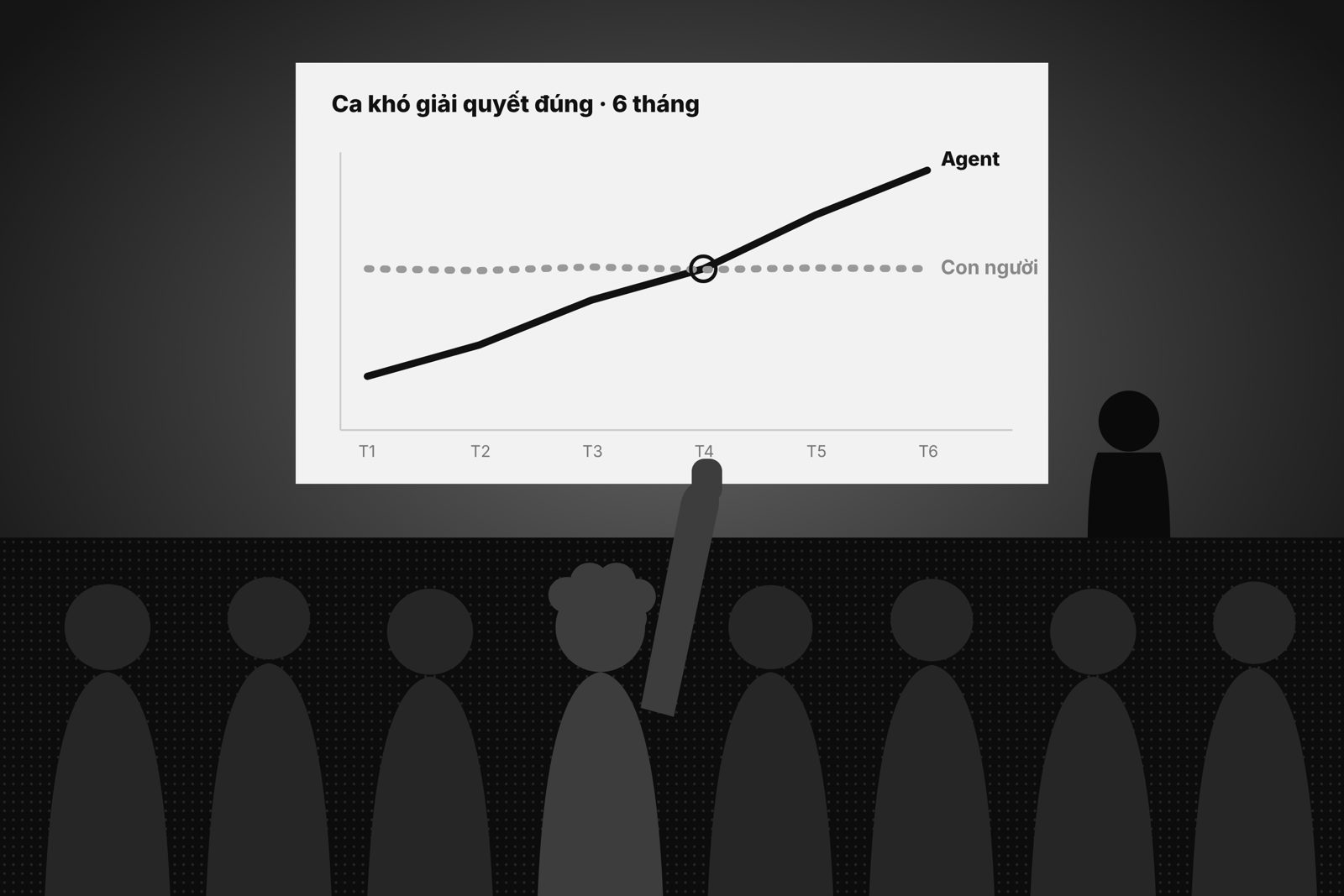
The next morning, the leadership team held a Q&A. The head of product, a young man who talked very fast and who, the whole company whispered, was about to become CEO, put a chart up on the screen. Over the past six months, in the test environment, the rate at which agents correctly resolved hard cases on their own had overtaken the operations team’s. The two lines crossed in the fourth month. From there, the agents’ line kept climbing, while the humans’ line lay still, flat as a lake with no wind.
“Any questions?”
Thắng Tất guessed the first hand up would belong to someone from the newest row of desks, people who hadn’t yet had time to learn the job. He guessed wrong.
The first hand up was Lực Sỹ’s.
“I have a question,” he said, his voice as calm as ever. “In the test environment, who defined what counts as resolved correctly?”
The head of product glanced quickly toward the back row before he answered: the ticket is closed, and the customer gives no negative feedback within seven days.
“Then the yarn lady’s case a few months ago would have counted as resolved correctly twice,” Lực Sỹ said. “Before it went wrong a third time.”
The room went silent. He went on, slower, as if setting each word down on the table:
“Agents don’t feel pain. They close tickets. If we pull people out of the hard cases, nobody in this company will see anything left to fix.”
Thắng Tất turned to look for Trung. Trung sat in the back row, arms folded across his chest, his face giving nothing away.
What Lực Sỹ had just said was, almost word for word, what Trung had said on the riverbank that day.
The One Who Taught Everyone to Find What Hurts
That afternoon, Thắng Tất found Lực Sỹ by the river, alone. No iced tea, no pencil. He sat hugging his knees, watching the barges drift past, slow and heavy as on any other day, as if the river had never heard the news.

“You were good this morning,” Thắng Tất said, sitting down beside him.
“Good, sure,” Lực Sỹ said. “But do you know why I said it?”
Thắng Tất laughed, because the question sounded so familiar. But Lực Sỹ didn’t laugh.
“For six years, my job has been seeing what the agents miss. The ‘report number’ column, the Monday morning ritual, all of it turns on one thing: the machine misses, the person catches. Now they’re saying the machine will catch it itself.” He picked up a pebble and turned it over in his palm. “So who am I, then?”
Thắng Tất didn’t know how to answer. He had never heard Lực Sỹ say so much at once, and he had never seen him look so small.
“Everything I said this morning was true,” Lực Sỹ went on. “But I didn’t say it because it was true. I said it because I’m scared. I borrowed Trung’s words to cover my fear. Isn’t that funny? The man who taught the whole team to go looking for what hurts, and now all he wants is for everything to stand still.”
The pebble dropped into the water without a sound.
A while later, Trung arrived. He was carrying three glasses of iced tea, as if he had known there would be two people sitting here waiting.
“I’m not angry that you used my line,” he said to Lực Sỹ. “It’s still true. It just isn’t the answer to this.”
He sat down. This time he didn’t take out the book. He recited from memory, slowly, like a poem he had known for years.
“There’s a passage in the book I read over and over every time the company is about to change. Success makes it easy to keep doing things the old way. Success makes you listen less. Success makes change hard. But the way you succeed today may not work tomorrow.” He looked out across the water. “You’ve been successful with ‘the machine misses, the person catches’ for too long, Lực Sỹ.”
“I know,” Lực Sỹ said quietly.
“In six years, you’ve changed the way this whole team works more times than I can count. But not once have you had to change your own role.” Trung paused. “The book has one more line. We fear change because we change so rarely. Once we change often, we stop being afraid, and change becomes a need.”
Nobody said anything more. The three of them sat there, each with a glass of iced tea slowly melting. On the far bank, the windows began to light up, one by one, as evenly as if someone had programmed them.
Theory corner – Status quo bias
In 1988, William Samuelson and Richard Zeckhauser published Status Quo Bias in Decision Making in the Journal of Risk and Uncertainty. Through experiments and real-world data, they showed that people tend to stick with their current choice more than is rational, simply because it is current. The same option, presented as “the way we do it now”, is chosen far more often than when it is just one of several equal alternatives.
The bias is strongest in precisely the people who have succeeded with the old way, because for them the old way is not just a process but part of who they are. Lực Sỹ wasn’t objecting because he was wrong. He was objecting because he had been right for too long.
Dynamic Stability
The next day, Trung asked to meet the head of product. All Thắng Tất knew was that the meeting lasted two hours, and when Trung came out he was holding a sheet of paper that had been almost entirely crossed out. That afternoon, a new plan went out to the whole company, under the head of product’s name.
That evening, Trung called Thắng Tất and Lực Sỹ into the small meeting room.
“I didn’t ask them to stop the project,” he said straight away. “I agree with it.”
Lực Sỹ looked up, but said nothing.
“The agents will keep getting better, whether we like it or not,” Trung said. “There’s a line in the book I love: change before you are forced to change, so that you are the one in control of the change. If our team stands outside and objects, in six months the project will still be running. Just without us in it. But if we step in, we get to decide which way it goes.”
“So what’s the crossed-out paper?” Thắng Tất asked.
Trung laid the sheet on the table. “The original plan was to switch on autonomy for every customer at once, from the first day of the quarter. I proposed something different. Switch on just ten percent more each week. And before anything is switched on, there has to be a set of rules: which cases an agent may handle on its own, and which must be sent back to a person. Our team writes those rules.”
He turned to Lực Sỹ.
“And I want you to write them.”
Lực Sỹ looked at the paper for a long time. “You’re letting the loudest objector write its rules?”
“I’m letting the person who knows best what agents tend to miss write its rules,” Trung said.
Thắng Tất looked down at the only line left on the paper that hadn’t been crossed out. Trung’s handwriting, slanting slightly: The best stability is dynamic stability. Change a little every day, and there is no upheaval.
Below it, so small it was almost invisible, was one more line: Stability that stands still is a stagnant pond.
Theory corner – Why change efforts fail
In 1995, John Kotter wrote Leading Change: Why Transformation Efforts Fail in the Harvard Business Review, later expanded into the book Leading Change (1996). From observing more than a hundred companies, he identified mistakes that came up again and again. Two of them are very close to the story at Hải Đăng: undercommunicating the vision (by a factor of ten, he wrote), and leaving obstacles in the way instead of empowering the people involved. He also stressed the role of visible, short-term wins in keeping the whole process moving.
A one-page announcement is a textbook case of undercommunicating. What Trung did, switching on ten percent a week and letting the objector write the rules, solved two things at once: it created a small win every week, and it turned the man on the outside into the one at the wheel.
The New Teacher
It took Lực Sỹ three weeks to write the rules. The first draft ran to forty pages. Trung read it and handed it back with a single sentence: “An agent doesn’t need forty pages. It needs to know when it doesn’t know.”
The final version was one page, with five rules.
The first rule came straight from the column he had built a few months earlier: If a CEO reports the same issue for the second time or more, the agent may not close the ticket on its own. The second came from the night before month-end: Any change one agent remembers must be passed on to the other agents in the same company. The third came from Dr. Diệp’s clinic: No agent may drop, on its own, a promise the customer has kept with their own people.
The fifth rule was the one he took longest to write, and also the shortest: When a CEO talks about how they feel, hand it to a person.
In the first week, ten percent of customers were switched to autonomy.
The queue went quiet. For the first time in two years, the chimes grew sparse, and then there were stretches of ten minutes without a single one. The whole second row sat in a strange silence, like guards at a border post after the border has been moved somewhere else.
The number of cases sent back to the operations team fell by half. But the ones that remained were far harder than before. No case was handled in four minutes, ten seconds anymore. Thắng Tất realized that at some point, without his noticing, the speed leaderboard had become meaningless.
In the third week, something happened that kept Lực Sỹ sitting silent all afternoon. An autonomous agent handled a complicated tax case for a one-CEO company. It did better than he would have. Faster, more thorough, and it even caught an extra mistake he might well have missed.
“You see,” he said to Thắng Tất, his voice neither glad nor sad. “It’s better than me.”
“In that case,” Thắng Tất said. “But your fifth rule sent eleven cases back to us this week. I read all of them. Not one of them could the agent have handled properly on its own.”
Lực Sỹ was quiet for a while. Then he opened the rules and added a note under the fifth: the ways CEOs tend to express their feelings without using words like “sad” or “angry”. The first example he wrote down was: It’s only me here, you know.
He worked on it until evening. On his way out, he stopped by Thắng Tất’s desk.
“You know, for six years my job has been catching what the agents miss. From this week, my job is teaching them to recognize where it hurts.” He smiled, for the first time in weeks. “Trung has a line from the book: the saddest thing in life is when today is the same as yesterday, and the same as tomorrow. I was sad for two years and didn’t know it.”
After he left, Thắng Tất stayed in his seat. The queue in front of him was empty. Somewhere among ten thousand companies, thousands of agents were reading, fixing and closing tickets on their own, quietly and flawlessly.
He stared at that empty screen for a long time, and then asked himself a question he didn’t dare write in his notebook: what if, one day, even the fifth rule was no longer needed?
Theory corner – Growth mindset
In Mindset: The New Psychology of Success (2006), psychologist Carol Dweck distinguishes between two beliefs about ability. People with a fixed mindset believe ability is something you either have or don’t, so every challenge is a test and every failure a verdict. People with a growth mindset believe ability can be developed, so challenges are chances to learn. Later research found that exercises meant to “install” a growth mindset have more modest effects than first hoped, but the core idea is still useful for taking a hard look at yourself.
When an agent does better at something you were once proud of, a fixed mindset hears it as a verdict: I’m not as good. A growth mindset asks a different question: so where do I need to get better now? It took Lực Sỹ three weeks to get from the first question to the second.
Thắng Tất’s Notebook
This time, he wasn’t the one who had changed. But Thắng Tất still wrote down three things:
- The loudest objector is often the one who has been right the longest. They aren’t afraid the new thing is wrong. They’re afraid it’s right, and that there’s no place in it for them. Before you argue with their reasoning, ask what they’re afraid of losing.
- Change before you are forced to change. If you stand outside and object, the change still comes, just without you in it. Step in, and you get to steer.
- The best stability is dynamic stability. Ten percent a week is far easier than a hundred percent overnight. And once change becomes a habit, people stop being afraid of it.
At the very bottom, he copied out Lực Sỹ’s line: I was sad for two years and didn’t know it. Then he added, smaller: And me?
Over to you
- Is there something in the way you work that has succeeded for so long you no longer question it?
- The last time you objected to a change, were the reason you gave and the real reason the same?
- If an agent did better than you at something you were once proud of, what would your next role be?
- If you’re leading a change: who is the loudest objector, and what could you give them to do so they’re the one at the wheel?
Further reading: Samuelson & Zeckhauser, Status Quo Bias in Decision Making, Journal of Risk and Uncertainty (1988); John Kotter, Leading Change: Why Transformation Efforts Fail, Harvard Business Review (1995) and Leading Change (1996); Carol Dweck, Mindset: The New Psychology of Success (2006). Hải Đăng and all characters are fictional.