The Last Minute of the Meeting
The idea came to Thắng Tất on a Tuesday evening, while he was rereading the “Why” page for the fifth clinic.
Asked why they had rented agents, all five doctors gave almost the same answer: “So I can sleep.” None of them said “to have a receptionist agent”. None of them said “to send automatic reminders”. And yet Hải Đăng’s sales page still laid agents out like goods on a shelf: an accounting agent, a receptionist agent, a customer care agent, each with its own price. A CEO working alone had to fit them together herself, like assembling a wardrobe from instructions printed too small to read.
He wrote one line in his notebook and underlined it twice: What if we sold sleep, instead of selling agents?
That weekend was the monthly all-company meeting. Twelve people, all of Hải Đăng, filled the big meeting room. By custom, the last fifteen minutes were set aside for “new ideas”, and anyone could say anything.
Those fifteen minutes went exactly the way they did every month. The head of sales spent seven minutes on a discount campaign. The product director spent five on the progress of Project Autonomy. The two of them argued for another two. With exactly one minute left, Thắng Tất raised his hand.
He stood up. His heart was beating so fast he could hear it in his ears. He had practised his opening line three times in front of the bathroom mirror.
“I think we should sell around what CEOs worry about, instead of selling one type of agent at a time. Take the clinics, for example. They don’t need a receptionist agent, they need…”
“Interesting,” the head of sales cut in, in a very friendly voice. “But if we sell by worry, that’s a package for every industry. How would that ever scale? Write it up and send it to me.”
A few people nodded. The host thanked everyone. Chairs scraped. The meeting was over.
Thắng Tất sat down, his cheeks burning. He hadn’t even got as far as the word “sleep”.
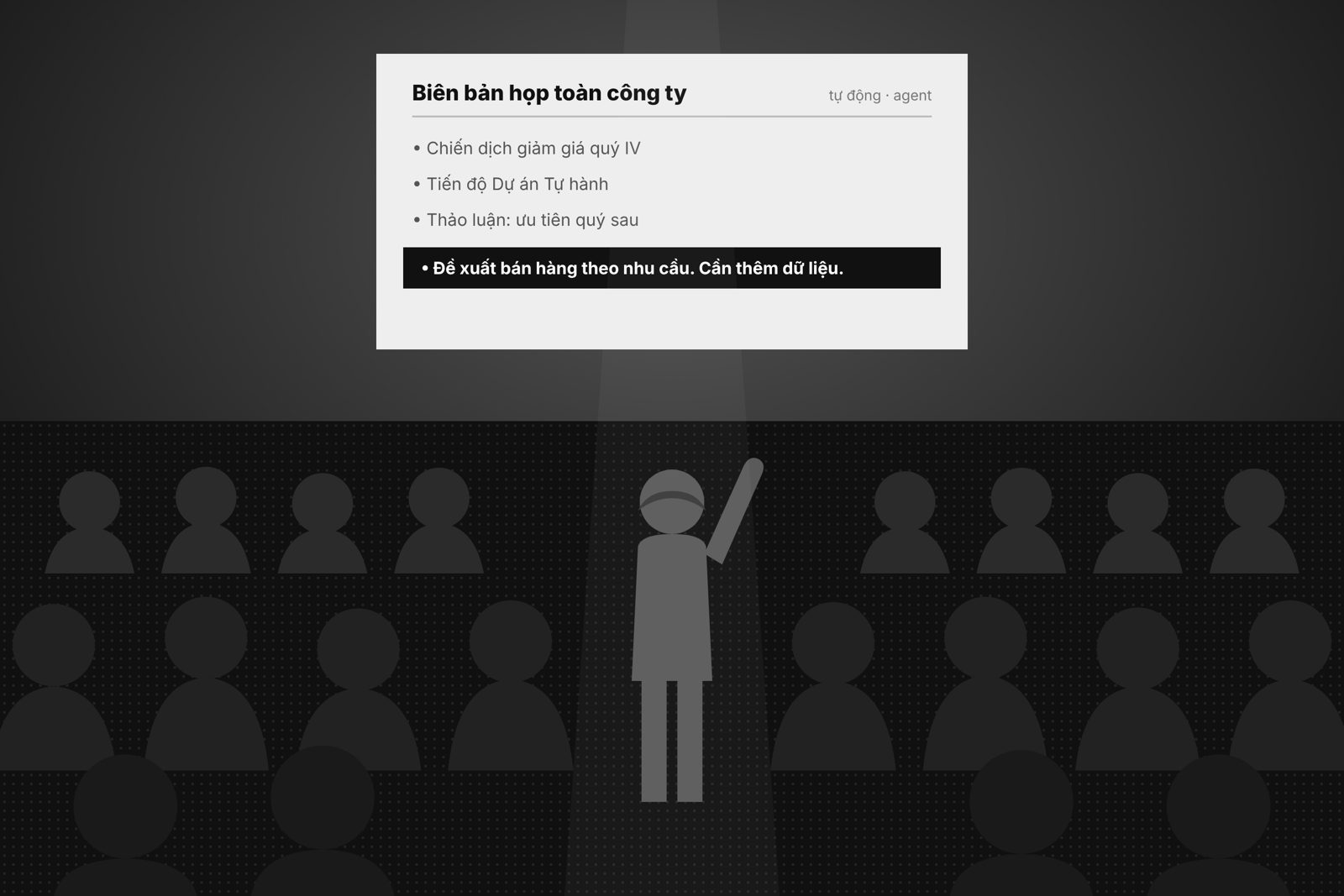
The meeting minutes, taken by an agent, appeared on the screen before anyone had even stood up. Neat, complete, no one left out. His contribution was summed up in a single line: Proposal to sell based on needs. More data required. The word “sleep” was nowhere to be found.
On the way back to his desk, he heard two of the new hires in the far row whispering to each other.
“I had an idea too. But after seeing Thắng Tất get cut off like that, forget it.”
Theory corner – Psychological safety
In 1999, Amy Edmondson published a study in Administrative Science Quarterly of 51 work teams in a manufacturing company. She defined psychological safety as a shared belief within a team that it is safe to speak up, ask questions, admit mistakes or put forward ideas without being embarrassed or punished. Teams with high psychological safety learned more and performed better. Years later, Google’s Project Aristotle, which studied more than a hundred of its own teams, also ranked this factor as the most important of all.
No one in that meeting room meant any harm. The head of sales even said “interesting”. But one friendly interruption in front of the whole company was enough to make two new hires quietly put their own ideas away. Trung’s book says something similar: in a crowd, opinions tend to drift toward consensus, and the many breed the ordinary.